Thumbelina
This is the whole tale, the same ten pages it runs in Pillowbook on the phone. Not a word is cut, and nothing asks you to sign up. The first three pages carry the paintings they were given; the rest of the plates are in the app, where the book is read one page to a screen.
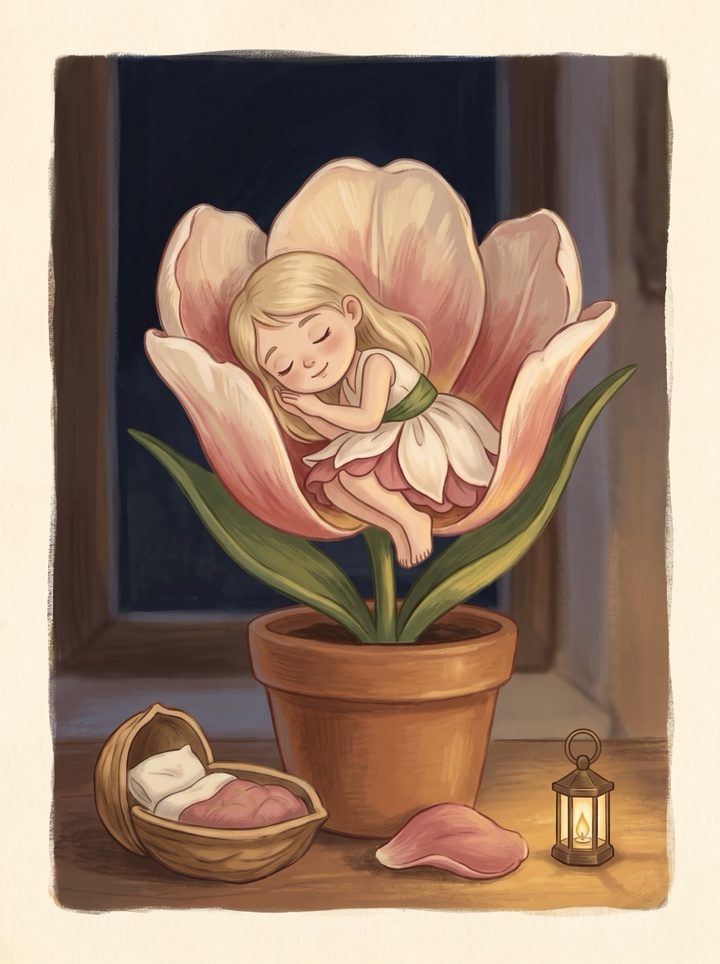
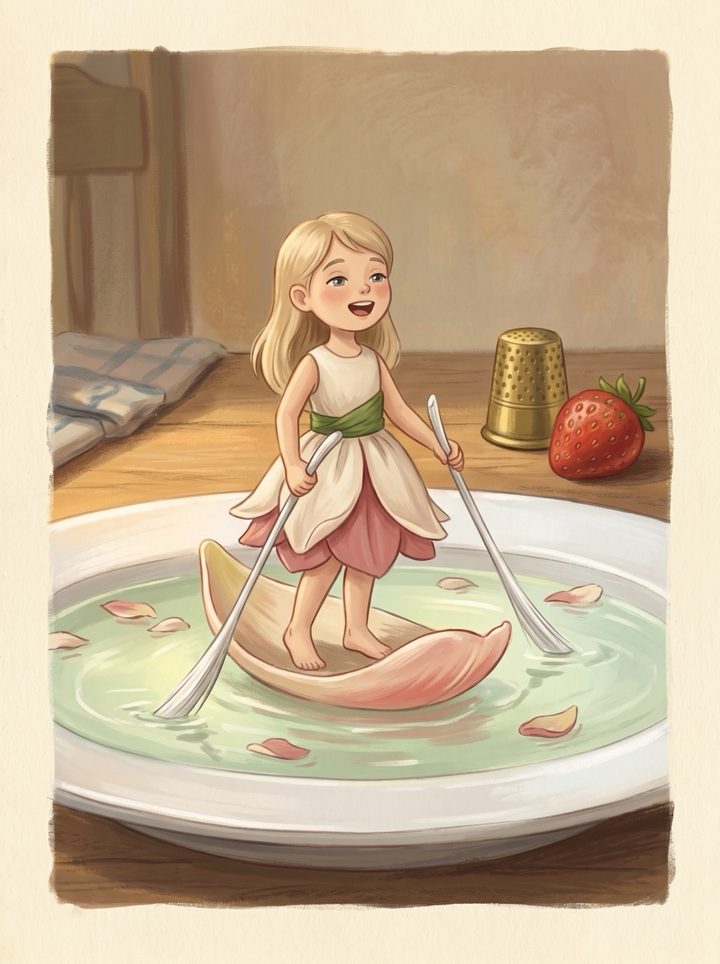
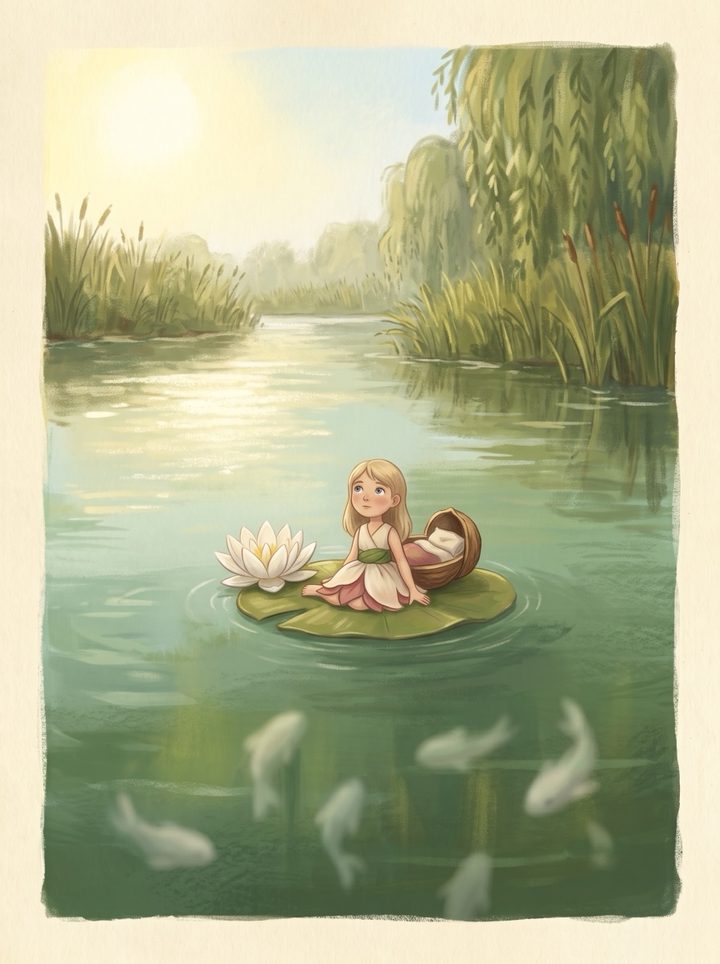
The fish under the pad had listened to her singing all spring and had liked it. They came up and nibbled through the stalk, and the leaf went off downstream with her standing on it. A white butterfly took hold of her ribbon and pulled, and the two of them travelled like that all afternoon, past fields and cattle and a town, going wherever the water went.
But summer does not last, and she had no coat. The leaf ran aground at a stubble field already going brown, and after that it was cold every night and colder every morning. She wrapped herself in a dry leaf and it was nothing like enough. Then she found a round door under a thistle with a light behind it, and knocked, and waited.
A fieldmouse in spectacles and a knitted shawl opened it, looked her over, and said she had better come in before she blew away. There was corn in the store rooms to last until May. Thumbelina swept, and told stories in the evenings, and was warm and fed and grateful, and knew perfectly well the whole time that it was somebody else's home.
A passage ran under the field, which the fieldmouse used as a short cut, and halfway along it one day Thumbelina found a swallow lying on the earth floor with his wings folded the wrong way. He was cold, and very tired, and had left it far too late in the year. The fieldmouse said that swallows were nothing but noise, and walked on.
Thumbelina went back with hay. She built it over him and round him until only his head was out, and laid her cheek against his warm brown back, and stayed there until she was too cold to stay any longer. She did that every day of the winter. Somewhere in February he opened one eye and looked at her, and after that he got better rather quickly.
By spring he was strong, and the burrow had opinions about her future. There was talk of a neighbour further down the passage with a great many rooms and no window in any of them. On the morning the swallow left he asked whether she was coming. Thumbelina thought about it for one second, climbed up onto his back, and took hold of a feather.
They came up through the thistle door into more sky than she had ever seen at once. He carried her south over woods and a lake and a long white road, and put her down in a meadow where the flowers stood taller than she did and every single one had somebody her own size sitting in it. She stayed. He built above her, and sang about the journey all summer.
The end.
Read any of them tonight, free
Classic fairy tales, ten painted pages each, one story an evening. No sign-up before you can read.
About this tale
Is this the full story?
Yes. All ten pages of Thumbelina are here, word for word, and the story ends where it ends. The paintings for the first three pages are on this page; the other seven are in the app.
Is it suitable for a three year old?
It is written for children between three and eight. She is taken from home more than once, which small children sometimes feel. She chooses where she stays at the end.
How long does it take to read aloud?
About five minutes at an unhurried pace, which is roughly one page every thirty seconds.
Where do the pictures come from?
They were painted for Pillowbook, one plate per page, in a single visual voice shared across every tale. They are not stock illustrations, which is why the full set is in the app rather than on the web.
Can I read the other tales here?
Yes. Every tale is on this site in full, free and without an account. The app is for reading them at bedtime — every plate, offline, no advertising, one page to a screen — and for the tale it writes about your own child.