Puss in Boots
This is the whole tale, the same ten pages it runs in Pillowbook on the phone. Not a word is cut, and nothing asks you to sign up. The first three pages carry the paintings they were given; the rest of the plates are in the app, where the book is read one page to a screen.
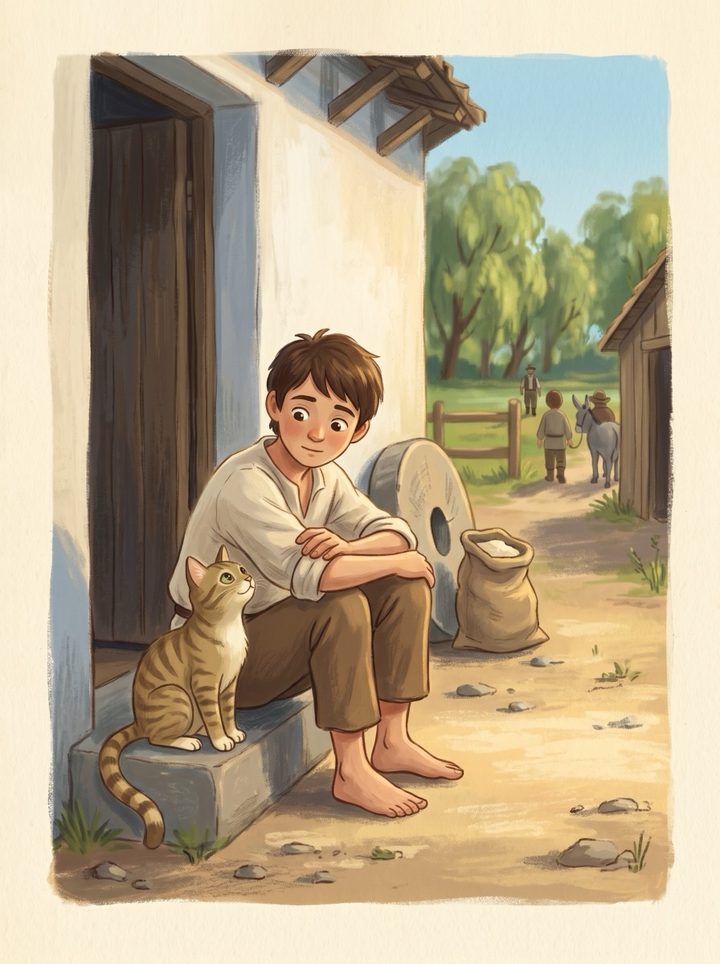
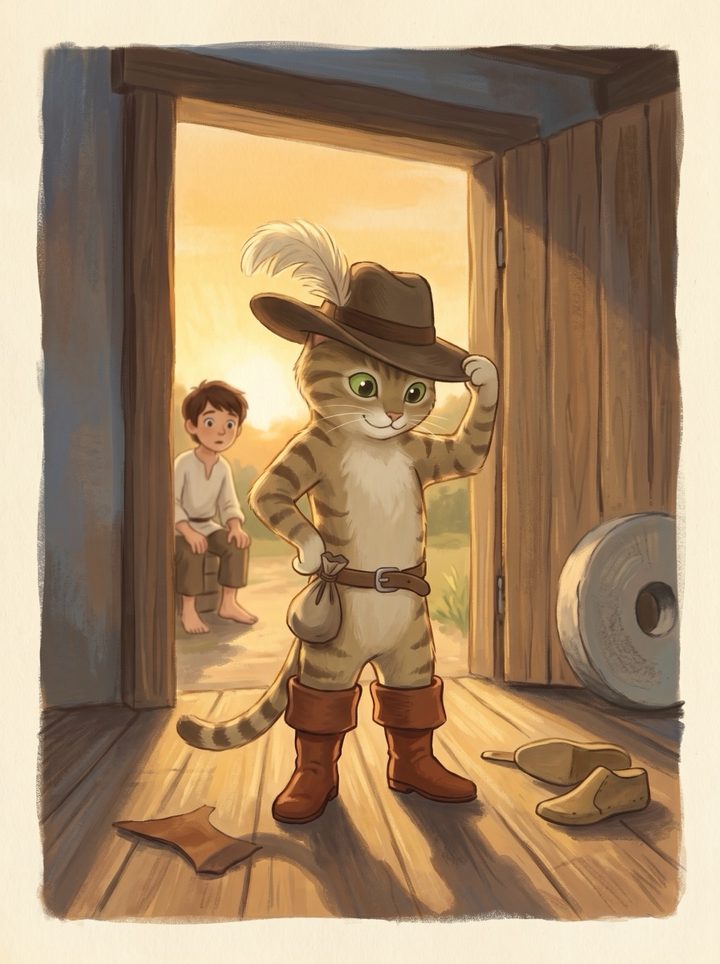
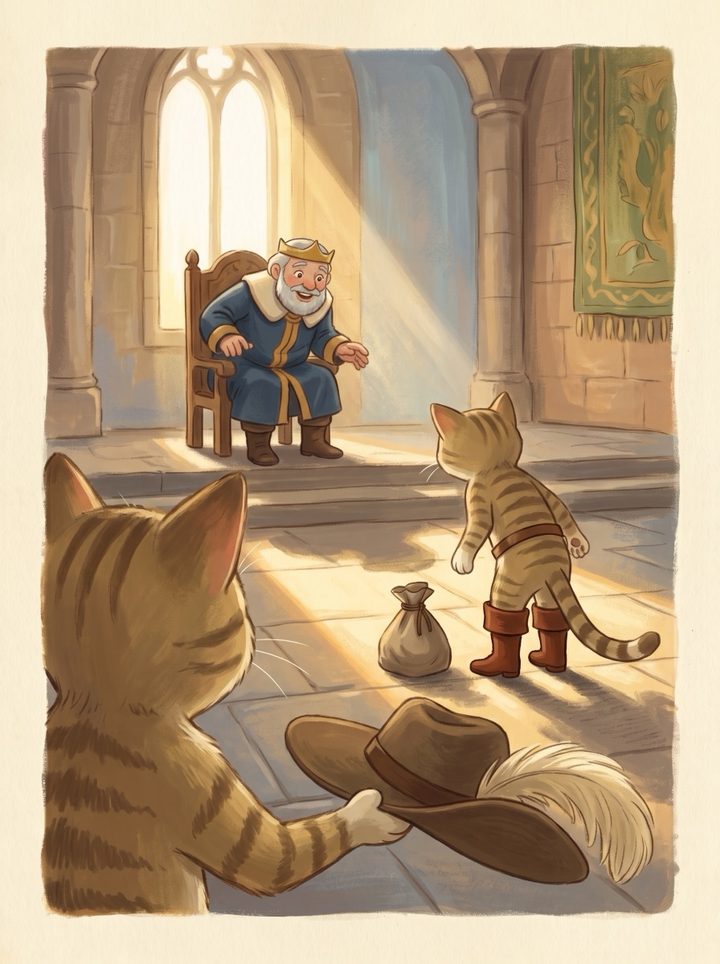
After that it was partridges, and then more rabbits, and then a basket of trout. It went on for two months. The king began to look forward to Thursdays. He asked questions about the Marquis and got answers that were long and warm and entirely without facts, and by the end of it he felt he knew the man rather well and rather liked him.
Then the cat learned that the king would drive along the river on Friday. He got his master into the water for a swim, hid his clothes under a stone, and stood at the roadside waving his hat and calling that the Marquis had been robbed. The king stopped at once. He had a spare coat in the carriage, and he was delighted to be of use.
The cat went on ahead. He found mowers in a hayfield, sat on the gatepost, and told them what a fine thing it was to work land belonging to the Marquis of Carabas, and how the king himself was coming to see it, and would they like to be in a story. They said they would. They said it all afternoon, to everybody who asked.
The castle at the end of the road belonged to a giant in a gaudy waistcoat, who could turn into anything at all and would tell you so before you had taken your hat off. The cat admired the waistcoat. The cat admired the hall. Then he said he had heard the giant could be a lion, but had not believed it, being a cautious sort of cat.
There was a lion in the hall for about four seconds. The cat applauded from the top of a cupboard and said it was very fine, but that any large thing can be a large thing, and the real trick would be something small. A mouse would be beyond anybody. The giant said the word "beyond" twice, in a rising voice, and then became a mouse.
He stepped down, walked past him, and held the great door open. The mouse looked at the door, and at the cat, and went out through it into the long grass and kept going. Nobody chased him. Nobody ever saw him again. The cat shut the door, straightened his hat in the window glass, and told the cook there would be eight for supper.
The carriage came up the drive, and the cat was on the steps under the banners, bowing so low his plume touched the stone. There was a feast in the courtyard that evening and the king laughed until he had to put his cup down. His master got the castle, and never once had to explain himself. And the cat sat in the warm light with one boot off, half asleep, entirely satisfied.
The end.
Read any of them tonight, free
Classic fairy tales, ten painted pages each, one story an evening. No sign-up before you can read.
About this tale
Is this the full story?
Yes. All ten pages of Puss in Boots are here, word for word, and the story ends where it ends. The paintings for the first three pages are on this page; the other seven are in the app.
Is it suitable for a three year old?
It is written for children between three and eight. Cheerful from beginning to end. The cat bluffs; nobody is hurt.
How long does it take to read aloud?
About five minutes at an unhurried pace, which is roughly one page every thirty seconds.
Where do the pictures come from?
They were painted for Pillowbook, one plate per page, in a single visual voice shared across every tale. They are not stock illustrations, which is why the full set is in the app rather than on the web.
Can I read the other tales here?
Yes. Every tale is on this site in full, free and without an account. The app is for reading them at bedtime — every plate, offline, no advertising, one page to a screen — and for the tale it writes about your own child.