Drag the pole. Get the stair.
Stair calculator and stringer layout for builders: risers, treads and run in tape-measure fractions, with framing-square (tongue/blade) settings and every notch mark along the stringer edge.
// what you take to the saw
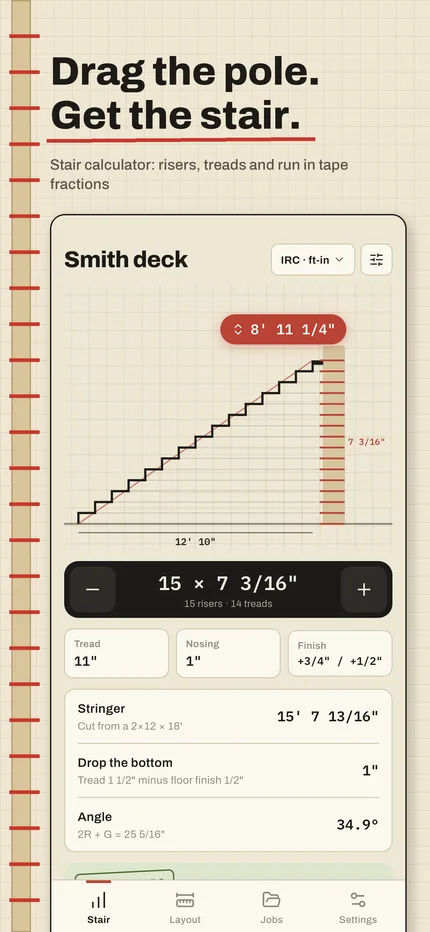
The numbers, the way your tape reads them.
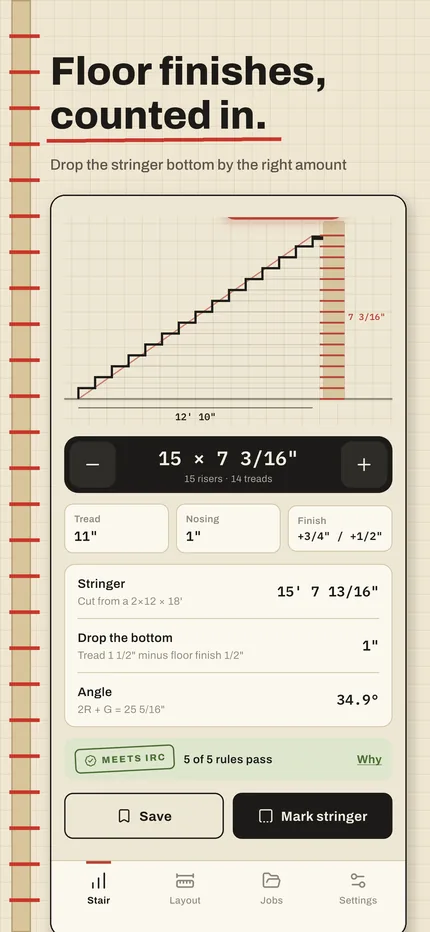
Measure floor to floor, set the pole, and the whole stair comes back at once: riser and tread, the square settings, how much to drop the bottom of the stringer, and where every notch goes.
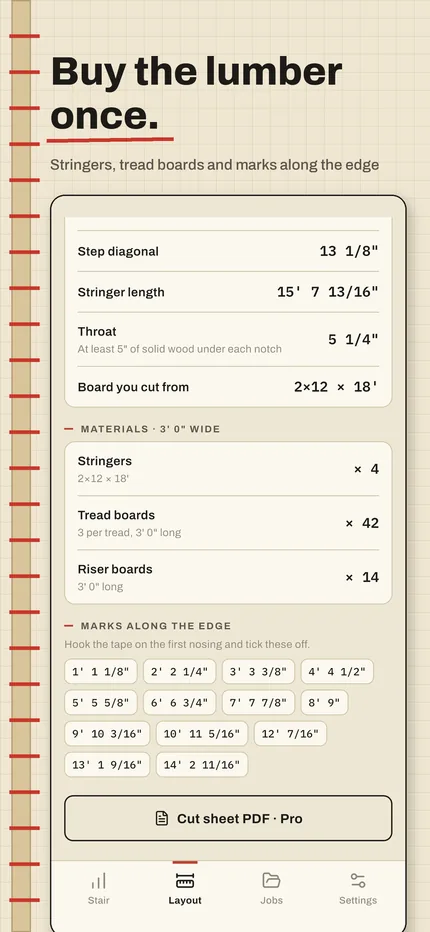
Marks along the edge: hook the tape on the first nosing and tick these off.
- 1′ 1 1/8″
- 2′ 2 1/4″
- 3′ 3 3/8″
- 4′ 4 1/2″
- 5′ 5 5/8″
- 6′ 6 3/4″
- 7′ 7 7/8″
- …
Example job from the screenshots. Feet, inches and fractions down to 1/32″, or metric with one switch.
// features
From the measurement to the lumber order.
A story pole you drag
Measure floor to floor and drag the pole to the total rise, or type it. The risers, treads and run follow the pole, so you see the steps change before you commit to a number.
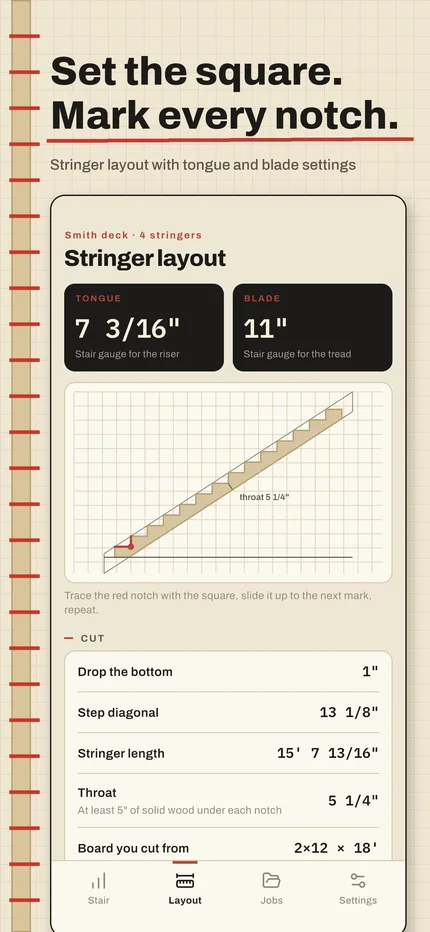
Stringer layout drawing
A drawing of the cut stringer with the framing-square settings, the drop at the bottom so the first step matches the rest, and the throat of solid wood under each notch.
Code checks for five countries
IRC (US), Approved Document K (UK), NBC (Canada), NCC (Australia) and DIN 18065 (Germany). Every rule shows the section it comes from, so you can look it up yourself.
Floor finishes counted in
Enter the thickness of the top and bottom floor finish and the first and last riser come out equal once the floors go down instead of one tall step and one short.
A materials list
Stringers with the stock length to buy, tread boards and riser boards. It warns you when the stringer is longer than any stock board and you need a landing.
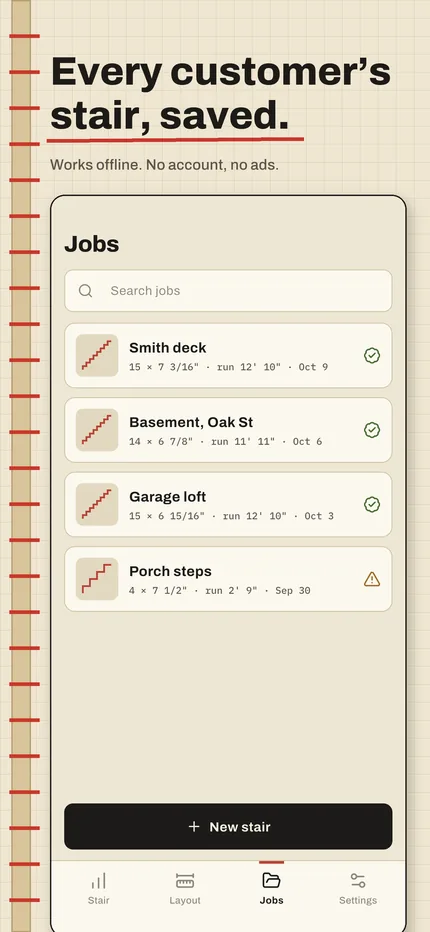
Saved jobs
One job per customer: the deck, the basement, the garage loft. Each keeps the code it was built with. Everything stays on your phone, works offline, no account and no ads.
// code checks
Pass inspection the first time.
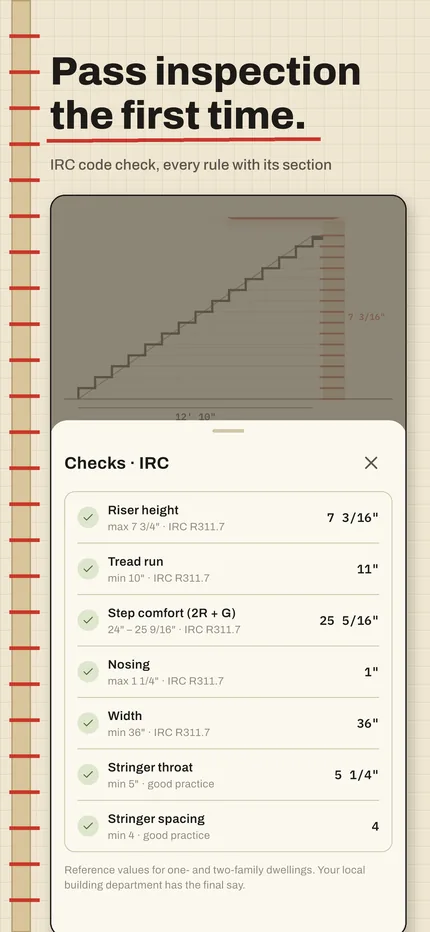
Pick the code you build to and every rule is checked as you change the stair. These are the main limits for a private stair in a house.
| Code | Section | Riser | Tread / going | Also checked |
|---|---|---|---|---|
| IRCUnited States | R311.7 | ≤ 7 3/4″ | ≥ 10″ | Headroom 6′ 8″, width 36″, nosing 3/4–1 1/4″ |
| Approved Document KEngland, UK | Private stair | 150–220 mm | 220–300 mm | Pitch ≤ 42°, 2R+G 550–700 mm, headroom 2.0 m |
| NBCCanada | 9.8.4, private stair | 125–200 mm | 255–355 mm | Headroom 1.95 m, width 860 mm, nosing ≤ 25 mm |
| NCCAustralia | Housing Provisions, stairs | 115–190 mm | 240–355 mm | 2R+G 550–700 mm, ≤ 18 risers per flight, headroom 2.0 m |
| DIN 18065Germany | Dwelling, ≤ 2 units | 140–200 mm | 230–370 mm | 2R+G 590–650 mm, headroom 2.0 m, width 800 mm |
- Riser
- ≤ 7 3/4″
- Tread
- ≥ 10″
- Headroom
- 6′ 8″
- Width
- 36″
- Rise
- 150–220 mm
- Going
- 220–300 mm
- Pitch
- ≤ 42°
- 2R+G
- 550–700 mm
- Rise
- 125–200 mm
- Run
- 255–355 mm
- Headroom
- 1950 mm
- Width
- 860 mm
- Riser
- 115–190 mm
- Going
- 240–355 mm
- 2R+G
- 550–700 mm
- Flight
- ≤ 18 risers
- Rise
- 140–200 mm
- Going
- 230–370 mm
- 2R+G
- 590–650 mm
- Width
- 800 mm
Reference values for one- and two-family dwellings. Codes get amended locally and inspectors read them on site. Your local building department has the final say.
// a look inside
Six screens, one stair.
// free and pro
The math is free. Pro keeps the paperwork.
Every code check and full precision are free. There is no paywall in front of a number.
Free
$0
- Every calculation, every code check, all five codes
- Full precision, down to 1/32″, or metric
- Stringer layout, square settings and notch marks
- Materials list
- 3 saved jobs
Stairgauge Pro
$29.99 lifetime · or $19.99 / year
- Unlimited saved jobs, one per customer
- Cut-sheet PDF: stringer drawing, square settings, materials
- Pay once with Lifetime, no subscription needed
Prices in US dollars; the store shows the price for your country. The yearly plan renews automatically unless cancelled at least 24 hours before the end of the current period, and the account is charged within 24 hours before that date. Cancel in Google Play › Payments & subscriptions › Subscriptions (on iPhone, once released: Settings › Apple Account › Subscriptions). The lifetime purchase never renews. See the Terms of Use and Privacy Policy.
// questions
The short version.
When can I get it?
Stairgauge is coming to Google Play first. The iPhone version follows after that.
Is the stair it gives me code-approved?
It checks the stair against the reference values of the code you pick and shows the section for each rule. Those values are for one- and two-family dwellings. Your local building department has the final say.
Do I need an account or a signal?
No. There is no account and nothing to log into, and it works offline. Your jobs are stored on your phone and are not uploaded anywhere. Details in the Privacy Policy.
What happens to my jobs if I don't buy Pro?
The free plan holds three saved jobs. Saved jobs never lock; Pro adds room for every customer's stair.
Measure once. Cut once.
Risers, treads, square settings and every notch mark, checked against your code. Offline, no account, no ads.