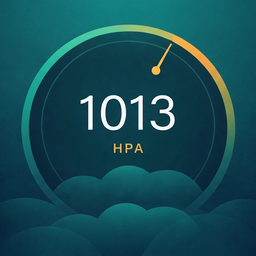
The weather, before it arrives.
Barometer reads the pressure sensor already in your phone and puts it on the instrument everyone knows - a brass-era aneroid dial. Where the needle sits tells you the weather now. Which way it has moved tells you the weather next.
A weather app tells you what a server thinks.
A barometer tells you what the air is doing where you are standing.
One reading, and where it came from.
Most phones since 2014 carry a barometric pressure sensor, sitting unused. Barometer reads it, corrects it to sea level so the number means the same thing at any altitude, and shows both figures so neither is mistaken for the other.
The aneroid face.
A 270° dial with the classic weather bands - stormy, rain, change, fair, dry - and a second, dimmer hand marking where the pressure stood three hours ago. On a real instrument you set that hand by hand; here it is placed for you.
Sea level and absolute.
The headline number is reduced to sea level, which is what forecasts and weather stations quote. The raw sensor reading stays visible underneath, labelled, so a reading 60 hPa lower at 500 m never looks like a fault.
hPa, inHg, or mmHg.
Pick the unit you were taught. The dial's own numerals change with it - 28.5 to 31.0 in inches, 720 to 780 in millimetres - so your reading is always somewhere you can find it on the scale.
Open it. The needle
is already there.
No account, no sign-up, no waiting on a network. The sensor is in the phone.
Read the pressure.
The sensor is sampled continuously and reduced to sea level, so the figure is comparable with any weather report.
Watch it move.
Every sample is logged. Two days of history on one chart, and a three-hour trend that says rising, steady, or falling - and how fast.
Read the forecast.
The trend, the season, and the wind go into the Zambretti forecaster and come out as one sentence about the next twelve hours.
History, forecast, and a storm alert.
A small instrument, finished properly, rather than a large one done roughly.
Two days of pressure.
A chart with a floor on its scale, so a settled high reads as the flat line it is instead of rendering sensor noise as a mountain range. High, low, and how long it has been recording.
The Zambretti forecaster.
A method from the 1910s that turned a barometer into a forecast, still around 90% right on the next twelve hours in settled weather. A method card says exactly which numbers produced the answer.
Storm alert.
A notification when the pressure falls past twice the marine rapid-change rate - the drop that precedes a squall - and at most one every six hours, so it stays a warning rather than a habit.
No sensor? Still works.
On a phone without a barometer, the reading comes from the nearest airport weather station instead, clearly labelled with the station it came from. Only the station code is ever sent.
Sixteen languages.
English, German, Spanish, French, Italian, Polish, Portuguese, Russian, Turkish, Indonesian, Vietnamese, Thai, Japanese, Korean, Arabic - forecast text included.
Nothing to sign into.
No account, no cloud, no advertising SDK in the build at all. Your pressure log lives on your phone and goes nowhere.
No account. No cloud. No ads.
Your location never leaves the device.
Both documents, in full.
Written for this app specifically - not a company template with the name changed. Barometer does no background tracking, has no home-screen widget, sells nothing, and carries no advertising SDK, and both documents say so.
Privacy Policy
What is read, what is stored, what is sent, and what is not. Location is used to reduce pressure to sea level and to find the nearest weather station - and never leaves your phone.
Read the policy →Terms of Service
What the app promises and what it does not. The forecast is a nineteenth-century method applied to a consumer sensor, and it is not a substitute for a meteorological service.
Read the terms →The short version.
Does my phone have a barometer?
Most mid-range and flagship phones from about 2014 onward do - it is there to help GPS settle on an altitude faster. If yours does not, Barometer says so plainly on the main screen and falls back to the nearest airport weather station.
How good is the forecast?
The Zambretti method has been quoted at around 90% accuracy for the next twelve hours in settled conditions, and it is much weaker in a fast-changing airmass. It is a single-instrument rule of thumb from the 1910s, not a numerical weather model. Treat it as what a barometer can tell you, because that is exactly what it is.
Does it need the internet?
No. The dial, the history, the trend, and the forecast all work with the phone in flight mode. A connection only adds the wind direction from the nearest station, which sharpens the forecast slightly.
What is sent off the device?
The four-letter code of the nearest airport weather station, about once every twenty minutes, and only if station calibration is left on. Never your coordinates. Crash reports and usage analytics are opt-in. See the Privacy Policy.
A barometer on the shelf in your pocket.
Currently in closed testing on Android. The Play listing follows shortly - the privacy policy and terms above are live now.
READ FIRST Privacy & TermsBarometer is a consumer measurement tool. Its pressure readings, trends, and forecasts are informational and must not be relied upon for aviation, marine, mountaineering safety, or any situation where an error could cause harm. The forecast is produced on-device by a historical single-station method and is not a meteorological service. Always consult an official weather authority for severe-weather decisions.